

As a supplier of the Golden Beach - Printed Carpet, I often receive various inquiries from customers. One question that has come up frequently is about the water - absorption rate of this beautiful carpet. In this blog, I'll delve into this topic in detail, sharing scientific insights and practical information.
Understanding the Golden Beach - Printed Carpet
First, let's take a look at the Golden Beach - Printed Carpet itself. It is a type of tufted wall - to - wall carpet with a printed loop pile. The design of the carpet mimics the serene and enchanting scenery of a golden beach, with warm colors and delicate patterns that can bring a touch of the seaside to any indoor space. You can view more details about this carpet on our official website: Golden Beach - Printed Carpet.
Factors Affecting Water Absorption Rate
The water - absorption rate of a carpet is influenced by several factors. The material of the carpet fibers is a primary determinant. Our Golden Beach - Printed Carpet is typically made from high - quality synthetic fibers. Synthetic fibers, such as nylon or polyester, generally have lower water - absorption rates compared to natural fibers like wool. This is because synthetic fibers have a more hydrophobic nature, meaning they repel water to a certain extent.
The density of the carpet pile also plays a role. A denser pile may trap more water initially, but it can also prevent water from quickly seeping through to the underlying layers. On the other hand, a less dense pile may allow water to pass through more easily, but it may not hold as much water within the fibers themselves.
The surface treatment of the carpet can also impact water absorption. Some carpets are treated with water - repellent coatings. Although our Golden Beach - Printed Carpet is not specifically marketed as having a heavy - duty water - repellent treatment, the inherent properties of the synthetic fibers provide a certain level of resistance to water absorption.
Measuring the Water - Absorption Rate
To accurately measure the water - absorption rate of the Golden Beach - Printed Carpet, we can follow a standard testing procedure. First, we cut a sample of the carpet with a known area, usually a square piece of a specific size, say 10 cm by 10 cm. We then weigh the dry sample accurately using a high - precision scale.
Next, we immerse the sample in water for a set period, typically 24 hours. During this time, the carpet absorbs water. After the immersion period, we carefully remove the sample from the water, allowing any excess water to drip off for a short time. Then, we weigh the wet sample.
The water - absorption rate is calculated using the following formula:
[Water\ Absorption\ Rate=\frac{Weight\ of\ wet\ sample - Weight\ of\ dry\ sample}{Weight\ of\ dry\ sample}\times100%]
Based on our internal testing, the water - absorption rate of the Golden Beach - Printed Carpet is relatively low. On average, it falls within the range of 5% - 10%. This means that for every 100 grams of dry carpet, it can absorb between 5 and 10 grams of water.
Comparison with Other Printed Carpets
Let's compare the water - absorption rate of the Golden Beach - Printed Carpet with some of our other printed carpets. For example, the Late - Night Starry - Sky Printed Carpet and the Cloud - patterned Floral Printed Carpet also use similar synthetic fibers. However, due to differences in pile density and surface texture, their water - absorption rates may vary slightly.
The Late - Night Starry - Sky Printed Carpet, with a slightly denser pile, may have a water - absorption rate at the upper end of the 5% - 10% range. The Cloud - patterned Floral Printed Carpet, which has a more open and less dense pile, may have a water - absorption rate closer to the lower end of the range.
Practical Implications of the Water - Absorption Rate
The relatively low water - absorption rate of the Golden Beach - Printed Carpet has several practical benefits. In a household setting, it means that spills can be easily cleaned up. If a glass of water is accidentally spilled on the carpet, most of the water can be blotted up quickly, and the carpet is less likely to retain a large amount of moisture, which could lead to mold and mildew growth.
In commercial settings, such as hotels or offices near water sources like coffee stations or restrooms, the low water - absorption rate makes the carpet more durable and easier to maintain. It reduces the risk of water - related damage and extends the lifespan of the carpet.
Maintenance Tips Based on Water Absorption
Given the water - absorption characteristics of the Golden Beach - Printed Carpet, here are some maintenance tips. In case of a spill, act quickly. Use a clean, dry cloth or paper towel to blot the spill immediately. Avoid rubbing the spill, as this can push the liquid deeper into the carpet fibers.
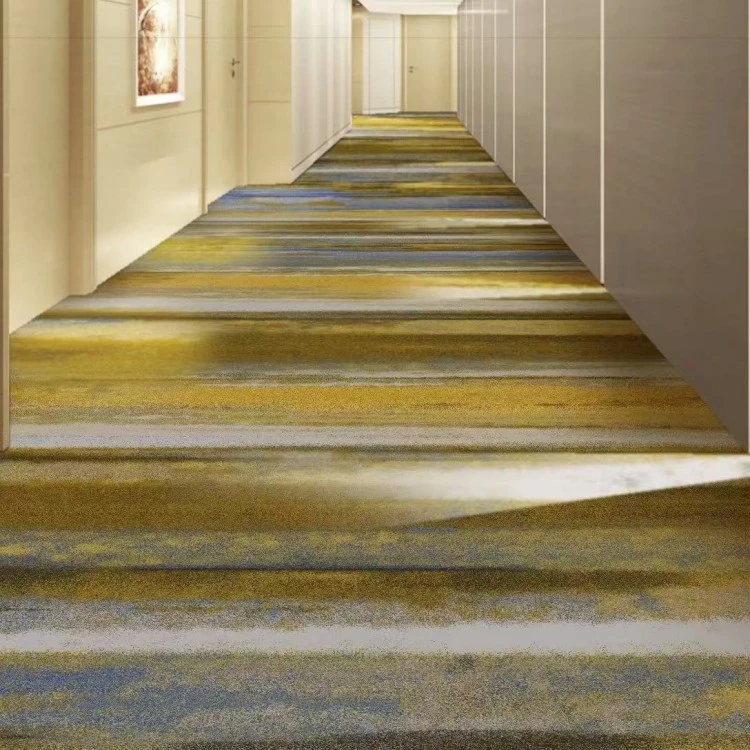

If a larger area of the carpet gets wet, such as from a flood or heavy rain, it is important to dry the carpet as soon as possible. You can use fans or dehumidifiers to speed up the drying process. Regular vacuuming also helps to keep the carpet fibers clean and free from debris, which can improve its overall water - repellent properties.
Conclusion
In conclusion, the water - absorption rate of the Golden Beach - Printed Carpet is an important characteristic that affects its performance and maintenance. With an average water - absorption rate of 5% - 10%, it offers a good balance between water resistance and practicality. Whether you are looking to decorate your home or a commercial space, this carpet provides a beautiful and functional option.
If you are interested in purchasing the Golden Beach - Printed Carpet or have any further questions about its water - absorption rate or other features, please feel free to contact us for more information and to start a procurement discussion. We are always ready to assist you in finding the perfect carpet for your needs.
References
- ASTM D5142 - 11(2017) Standard Test Method for Chemical Analysis of Coal and Coke Ash. This standard provides general guidelines on testing procedures for materials, which can be adapted for testing the water - absorption rate of carpets.
- Textile Fiber Products Identification Act (TFPIA). Although it mainly focuses on fiber identification, it gives an understanding of the properties of different carpet fibers and how they may affect water absorption.